

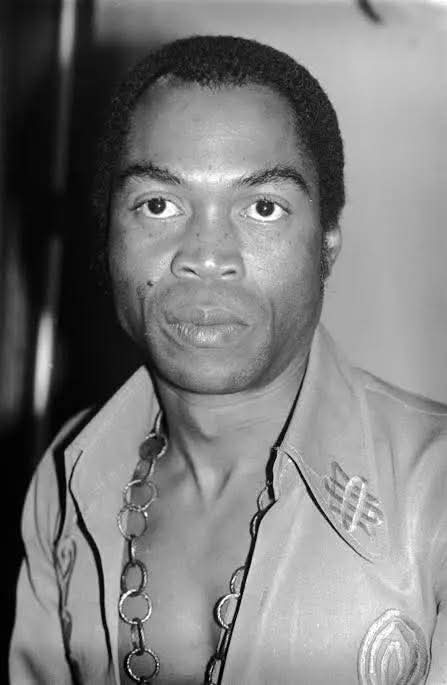
Is Wizkid Greater Than Fela Or Have We Forgotten What Fela Truly Stood For?|•Ogungbile Emmanuel Oludotun
I NEVER met Fela Anikulapo-Kuti. I was born the same month he died. There was no moment where I watched him command a stage, no memory of Kalakuta Republic in real time, no lived experience of his daily defiance against military power. In fact, my generation arguing on X(Twitter) did not meet Fela in flesh and blood; we encountered him in fragments, through stories, documentaries, old interviews, cracked vinyls, protest chants, and the stubborn way his name refuses to fade.
Yet somehow, despite not being there, his greatness still reached me. That, perhaps, is the first lesson in what true greatness means. It does not require presence to convince; it survives absence. Long after the man was gone, his work continued to speak so loudly that even those of us born after his death could not ignore it.
This is important to clarify, I am not a fan of Fela in the shallow, romantic sense. I do not admire his excesses. I do not like the way he smoked, the recklessness of his lifestyle, or the parts of his personal choices that are often conveniently brushed aside in the name of genius. I am not even a “fan fan” of his music in the everyday sense of enjoyment. However, I am deeply drawn to his stubbornness. I am a student of his message. I respect his refusal to bend. I admire his relentless insistence on African dignity, on freedom, on calling power by its real name. What fascinates me about Fela is not how he lived comfortably, but how he lived uncomfortably by choice.
I did not inherit Fela’s reputation through nostalgia or inherited worship. I arrived at it through evidence. By listening closely and realising that his music was not designed to soothe or entertain first. By reading history and discovering that his art was inseparable from bruises, arrests, exile, raids, and loss. By understanding that his legacy was not sustained by awards, streaming milestones, or global applause, but by consequence. Fela paid for his voice in ways charts cannot calculate. That is why, even without witnessing him live, I was convinced of his greatness. Not because he was popular, but because he was costly, to himself and to power.
This context matters, especially now, because the current argument around Wizkid and Fela did not grow out of a serious interrogation of history or cultural meaning. It erupted the way many Nigerian pop culture controversies do, on social media, powered by fandom bravado and careless exaggeration. What began as praise for Wizkid’s global achievements slowly slid into provocative claims by some of his supporters, boldly positioning the Afrobeats star as a modern replacement for Fela Anikulapo-Kuti. In the rush to celebrate charts, awards, stadiums, and international validation, Fela’s name was dragged into arguments designed more to win online battles than to honour legacy. Screenshots, tweets, and viral hot takes quickly pushed the comparison into Nigeria’s trending conversations.
Seun Kuti, Fela’s youngest son and one of the fiercest custodians of his father’s ideological memory, refused to stay silent. Through emotionally charged videos and blunt online rants, he described the comparison as ignorant and deeply disrespectful. To him, placing Wizkid beside Fela revealed a generation fluent in streams and stardom but unfamiliar with sacrifice, resistance, and consequence. His response, raw, confrontational, and unapologetic dragged the debate out of fan spaces and into mainstream national discourse.
The tension escalated further when Wizkid himself appeared to respond, not with a carefully argued position but with dismissive social media posts and reposted videos mocking Seun’s outbursts. At that point, what had been a fan-driven argument turned into a symbolic clash between two eras of Nigerian cultural expression. The debate stopped being just about music and became a mirror reflecting how Nigeria remembers its heroes, celebrates its stars, and repeatedly confuses popularity with historical significance.
This confusion is not accidental. In today’s Nigeria, fame has become shorthand for greatness. Streams are mistaken for substance. Sold-out shows are treated as moral authority. Social media dominance is confused with cultural weight. We now measure impact almost entirely by numbers, followers, awards, reach, without asking harder questions, What was said? Who was challenged? What system was confronted? What did it cost?
The word “legend” is now used so loosely that it risks becoming meaningless. Anyone with longevity, visibility, or viral relevance can be crowned one, even if their work never disrupted anything beyond playlists.
Meanwhile, there is no denying Wizkid’s greatness within his own context. From Ojuelegba to global stages, he has achieved what once seemed impossible for Nigerian pop artists. He helped carry Afrobeats into the global mainstream, shaping sound, ambition, and confidence for an entire generation. His influence on youth culture, fashion, and modern African identity is undeniable. Measured by commercial success and cultural relevance, Wizkid is one of Africa’s most successful musicians.
However, Fela was never defined by commercial success, and that is where the comparison collapses. Fela Anikulapo-Kuti was not merely an entertainer; he was a political force, a cultural disruptor, and a constant threat to authoritarian power. His Afrobeat was not crafted for approval or validation; it was a weapon. He named names, mocked dictators, endured arrests, beatings, exile, the burning of his home, and the death of his mother. His music cannot be separated from resistance, ideology, and consequence. To measure Fela by today’s metrics of success is to misunderstand his mission entirely.
This is why the question of “who is greater” often feels intellectually dishonest. Wizkid operates within a global entertainment industry that rewards diplomacy, branding, and strategic silence. Fela existed in a time when silence was submission and speaking out invited violence. Wizkid navigates power; Fela confronted it. Both approaches exist. Both have their place. But they are not interchangeable.
Perhaps the real issue is not Wizkid versus Fela, but Nigeria’s discomfort with complexity. We struggle to hold two truths at once: that Wizkid is a global icon of modern African music, and that Fela remains an unmatched symbol of cultural resistance and political courage. One is a superstar of his era; the other is a historical force whose relevance outlived his life.
In the end, asking whether Wizkid is greater than Fela says more about our obsession with rankings than about either man’s legacy. Wizkid does not need borrowed mythology to validate his success. Fela does not need modern approval to remain great. Greatness is not always loud, popular, or profitable. Sometimes, it is simply the ability to still convince generations that never met you. Anything else is not cultural debate, it is just another rubbish talk: viral, noisy, and empty.
•Ogungbile Emmanuel Oludotun Publisher BriefingBrewNews.com