

Education Tech Expert Urges Parents, Government To Embrace AI In Tackling Mathematics Failure
•••As Darsel Partners Oyo Govt. In Training Public School Students
•By OYENIYI AWOJOODU
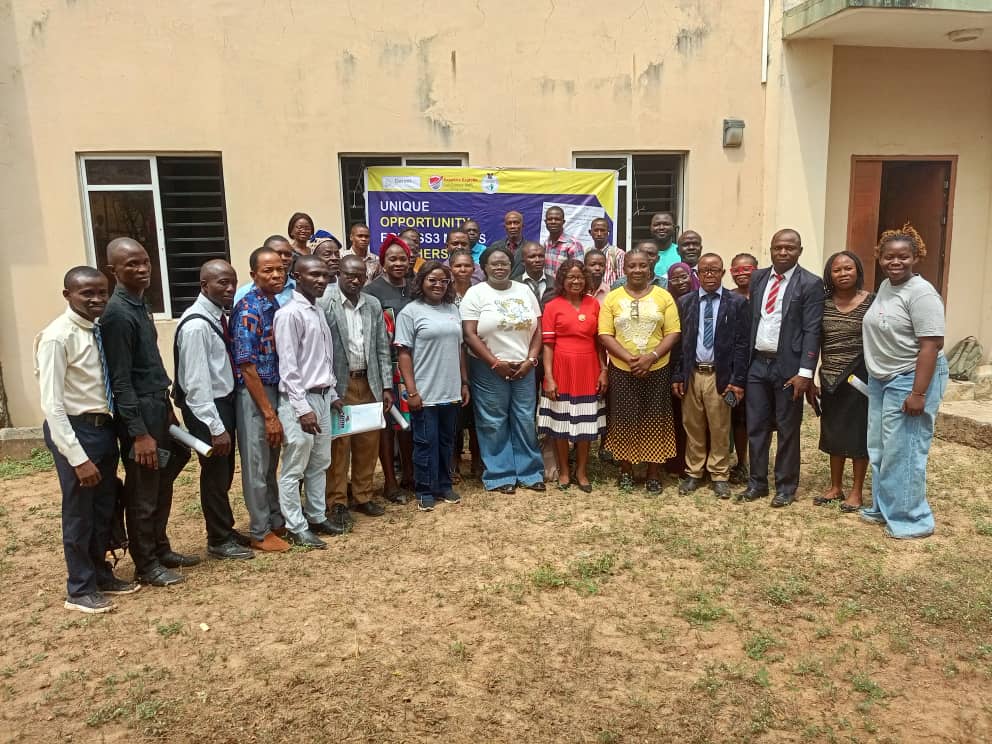
IBADAN — AN education technology expert and Country Implementation Partner for the Darsel Learn-by-Text Mathematics Chatbot, Mrs. Wunmi Tolu-Alalade, has called on parents, educators, government authorities and other stakeholders to embrace artificial intelligence-driven learning solutions as a strategic response to the persistent challenge of poor mathematics performance among Nigerian students.
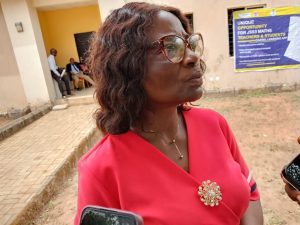
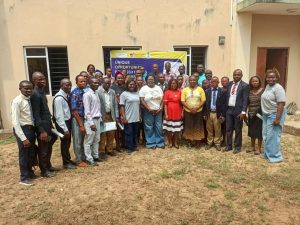
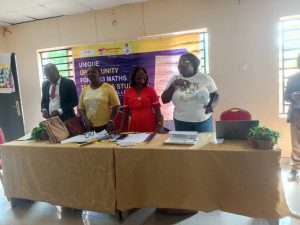
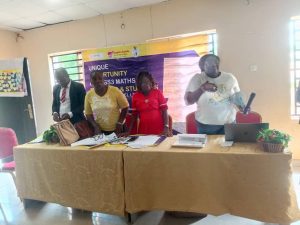
Speaking in Ibadan at Lagelu Grammar School on Wednesday during an interactive session with teachers and education stakeholders, Tolu-Alalade who also leads Sapphire Exploits 21st Century Skills Consultancy described the AI-powered chatbot as an innovative, gamified learning tool designed to strengthen mathematics proficiency among junior secondary school students, particularly those in Basic 7 to Basic 9( JSS1- 3)
According to her, the platform aligns strictly with the Nigerian national mathematics curriculum, providing structured question banks across all core topics taught within the three-year junior secondary cycle.
She explained that the initiative is currently being piloted among Basic 9 (JSS3) students in Oyo State, targeting candidates preparing for promotional examinations into senior secondary school. The programme, she noted, adopts a gamified learning model where students progress through difficulty levels, building confidence while mastering foundational mathematical concepts.
“This is artificial intelligence powered, but it is also child-friendly and entertaining. Students start from simple levels, and as they improve, they move up. Even children who naturally dislike mathematics begin to develop interest through consistent engagement,” she said.
The educator disclosed that the chatbot was first deployed in Lagos during her time as a classroom teacher, with pilot projects introduced across public and private schools around 2019 and expanded during the COVID-19 lockdown period to support remote learning.
She said the early adoption recorded significant success, particularly among public school students in Lagos with limited access to digital learning infrastructure.
“We deliberately focused on public schools because many of those students do not have computers or tablets. The chatbot works on basic mobile phones and requires minimal data. It is free to use, so it removes financial barriers to digital learning,” she explained.
Tolu-Alalade stated that mathematics performance among participating students improved markedly, with average scores rising from low pass rates to between 81 and 100 percent in some assessment categories. She attributed the improvement to daily practice culture encouraged by the platform.
“Practice builds mastery. We only ask students to spend 15 minutes daily. That habit alone transforms their confidence and ability over time,” she said.
Tolu-Alalade emphasized that artificial intelligence should not be viewed as a replacement for teachers but as a complementary support system capable of easing classroom pressure and enabling personalized learning.
“Teachers are overburdened. AI tools like this help students practise independently while giving teachers performance reports to identify learning gaps,” she said.
She further called for stronger collaboration among government agencies, school administrators, and parents to deepen adoption, stressing that Nigeria’s future competitiveness in science, technology, engineering, and medicine depends heavily on mathematics proficiency.
“Every profession requires mathematics, medicine, engineering, aviation, accounting. If we fail to build confidence early, we limit our children’s future. AI gives us the opportunity to change that story,” she added.
Also speaking, Mrs. Bosede Abiodun, a director in the Mathematics and Technical Department of the state Ministry of Education in Oyo State, confirmed that early testimonies from schools show measurable improvement in students’ attitudes toward mathematics.
“Some students who previously disliked mathematics are now showing interest. Teachers have shared success stories of learners whose performance improved significantly after using the platform,” she said, urging the government to provide institutional support to sustain and expand the initiative.
A mathematics teacher, Mr. Fowotade Adeniyi, described the innovation as simple to use and highly motivational for learners.
“When students answer correctly, the chatbot responds with encouraging words like ‘Excellent’ and ‘Well done.’ When they get it wrong, it gives hints before the solution. This motivates them. Many who feared mathematics now attempt questions confidently,” he said.
He added that the tool has been particularly beneficial for less-privileged students who may not have access to extra lessons or private tutoring, noting that daily exposure to practice questions has helped close learning gaps.
The Darsel platform operates through a WhatsApp-based chatbot that allows students to access unlimited mathematics questions, receive instant feedback, and track progress over time. Teachers, on their part, receive performance reports used to monitor learners and design targeted interventions.
Beyond Oyo State, the AI learning solution is also being implemented in Lagos State, Ondo State and the Federal Capital Territory, with pilot schools nominated by state education authorities. In Oyo alone, 28 schools are currently participating in the first phase, with capacity to scale statewide due to the chatbot’s AI backend and extensive question database.