

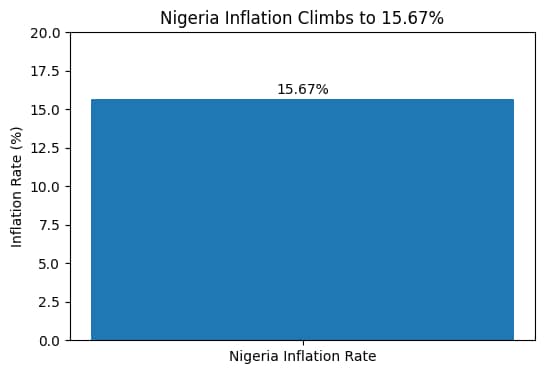
Nigeria’s Inflation Ticks Up To 15.69% In April
•By Admin
ABUJA — NIGERIA’S headline inflation climbed modestly to 15.69 per cent in April 2026, up from 15.38 per cent the previous month, according to fresh data released by the National Bureau of Statistics (NBS).
But economists and everyday Nigerians may find greater comfort in the longer view — the rate is a dramatic improvement on the searing 26.82 per cent recorded in April 2025, signalling that the worst of the inflationary storm may be easing.
The figures arrive on the heels of a significant methodological overhaul.
The NBS has completed a rebasing of its Consumer Price Index (CPI), now anchored to a new base year of 2024, with a weight reference period of 2023 — a move that provides a more accurate reflection of modern Nigerian spending patterns.
Under the new framework, the CPI climbed to 138.3 points in April, a 2.9-point rise from the preceding month.
While the year-on-year headline figure edged upward, month-on-month inflation actually slowed to 2.13 per cent in April, a notable retreat from the 4.18 per cent pace recorded in March. Analysts will view this deceleration as a positive sign that price pressures are becoming less aggressive on a day-to-day basis.
The NBS attributed the inflationary trend primarily to rising costs in food, transport, and hospitality-related services.
The biggest contributor to the headline figure was Food and Non-Alcoholic Beverages, which added 6.40 percentage points, followed by Restaurants and Accommodation Services at 3.56 percentage points, and Transport at 1.70 percentage points.
At the other end of the scale, Recreation, Sport and Culture, as well as Alcoholic Beverages, Tobacco, and Insurance and Financial Services, were the least significant drivers.
Food inflation came in at 16.06 per cent year-on-year in April — painful, but a far cry from the 24.68 per cent recorded in the same month last year. On a monthly basis, food inflation also eased slightly to 3.63 per cent from 4.17 per cent in March.
The NBS credited changes in the average prices of a broad basket of staples for the moderation, including millet, yam flour, fresh ginger, beef, garri, fresh pepper, beans, tomatoes, cassava, wheat grain, soybeans, guinea corn, plantain, carrots, and Irish potatoes.
Core inflation — which strips out volatile food and energy prices to reveal underlying trends — rose to 15.86 per cent year-on-year in April. However, on a monthly basis, it fell sharply to just 1.03 per cent, down from 4.03 per cent in March, suggesting that underlying price pressures outside the food and energy sectors are cooling considerably.
The newly rebased sub-indices paint a textured picture of where price pressures are most acute. Monthly inflation rates stood at 8.0 per cent for energy, 6.0 per cent for farm produce, 4.4 per cent for imported food, 3.2 per cent for goods, and 2.1 per cent for services.
On a year-on-year basis, farm produce led at 19.8 per cent, followed by services at 16.7 per cent, goods at 15.7 per cent, imported food at 10.5 per cent, and energy at 4.6 per cent.
The urban-rural divide in price pressures remains evident. Urban inflation stood at 15.40 per cent year-on-year, while rural areas bore a heavier burden at 16.36 per cent. On a monthly basis, however, rural inflation dropped sharply — from 6.73 per cent in March to 2.80 per cent in April — suggesting some meaningful relief for rural households.
Across Nigeria’s 36 states, the inflation experience varies wildly. Sokoto recorded the highest year-on-year headline inflation at 25.74 per cent, followed by Bauchi at 22.52 per cent and Zamfara at 22.03 per cent. In contrast, Edo State recorded the slowest rise at just 5.91 per cent, trailed by Borno at 6.72 per cent and Jigawa at 7.04 per cent.
For monthly food inflation, Niger State topped the chart at 8.53 per cent, while Enugu posted the highest year-on-year food inflation nationally at a staggering 32.67 per cent, followed by Kwara at 30.77 per cent and Adamawa at 30.14 per cent. Borno recorded the lowest food inflation at 1.67 per cent.
The NBS data provides the government and the Central Bank of Nigeria with fresh evidence as policymakers continue to navigate the balance between curbing inflation and stimulating economic growth.